Seeing Europe One Race at a Time
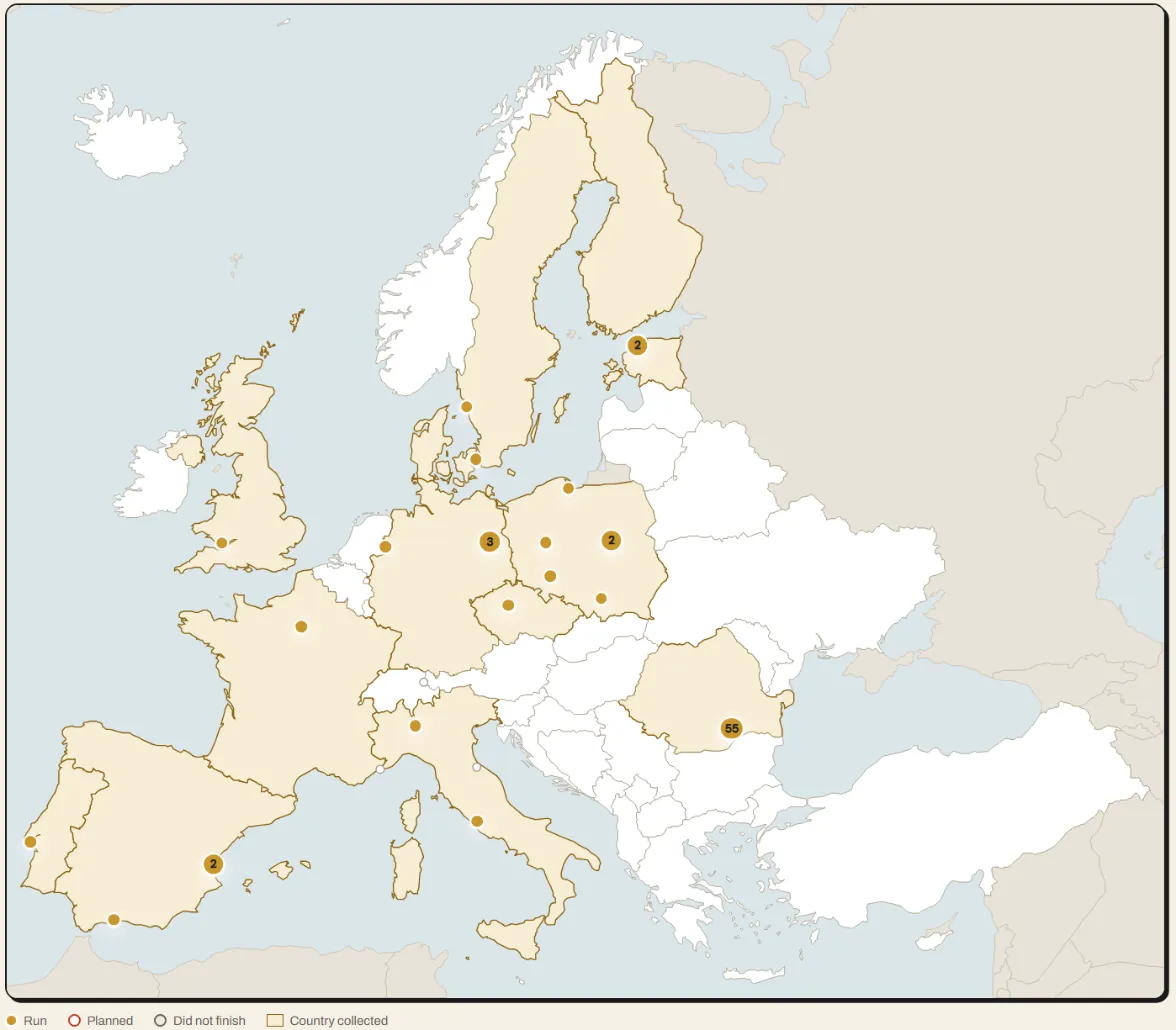
I wanted a map of every country I’ve raced in. So I built one.
These are affiliate links: if you book through them, I get a small commission at no extra cost to you.
I’ve always wanted a map.
Not a training map or a route map, just a simple map of Europe where I could see every country I’ve run a race in. One medal, one country, one more piece of the puzzle filled in.
For years, I tried to keep that map myself. I used various websites for marking visited countries, I even tried the travel app Mark O’Travel, and in the end I kept my own PNG map of Europe on my computer, updating it by hand after every race. Next to it, I had a Google Sheet with every race: the entry fee, the flights, the hotel, the train from the airport, and the total. At some point, the sheet had more tabs than I’d like to admit.
This is the story of how that map and that sheet became a website, and why it’s still a journey in progress.
A city looks different when you run through it
When I started running half marathons abroad, the plan was simple: run, try for a PB, fly home.
Surprisingly, it didn’t stay that way. Somewhere between Lisbon, Prague, Copenhagen, Cardiff, Valencia, Helsinki, Göteborg, Milan and Berlin, I realised I was seeing Europe in a way I never had as a tourist. You see a city differently when you run through it. In Lisbon, the start is on the 25 de Abril bridge over the Tagus. In Milan, the cobblestones of the old city slowed me down, but I didn’t mind at all. In Berlin, you finish near the Brandenburg Gate.
And I’ve ended up in places I would never have thought of visiting. For example, I would never have booked a weekend in Cardiff, and yet it gave me my season’s best in the rain.
Every race became a small trip, and every trip became a new country on my map. That’s when the idea of the EuroSlam came up: run a race in every European country. There are 44 of them, so it’s not a weekend project. It’s a live journey. So far I’ve collected 13 of 44, and the map is far from full.
From a Google Sheet to a website
I must admit, my Google Sheet worked for a long time. But every new race meant the same routine:
- Find the race, the date, and whether registration was open
- Check the weather for that weekend (you know how I feel about the sun)
- Look for flights from Bucharest
- Find a hotel within 2–3 km of the start, so I can jog there as my warm-up
- Add up the costs and update the sheet
- Colour in the country on my map when it was done
One evening, I decided to put all of it in one place. That’s how euroslam.run started: a personal project, built in my spare time, for runners like me who love travelling to races.
To be clear: it’s free, there’s no company behind it, and it’s not finished. It grows the same way my map does, one race at a time.
What it can do today
Here are the basics. Nothing fancy, but it’s everything I used to do by hand.
1. The map and the passport This is the heart of it. Every race you’ve run becomes a pin on your map of Europe, and every new country gets a medal in your passport: 44 countries, one medal each. If you want, you can make your profile public and share it with your running friends.
2. A race calendar with the details I always looked for There are currently more than 280 marathons and half marathons in 41 countries. Each race page has the date, the entry fee, the elevation, a speed score from 1 to 10, the average race-day weather over the last three years, and a rough trip budget.
3. Trip planning When you pick a race, you can turn it into a trip with an overview, a race-day page, a budget, a packing list, and a small checklist: entry paid, hotel booked, travel booked, bib collected. To be honest, that checklist is my old Google Sheet in four lines.
4. Flights with Google Flights Set your home city once, and every race shows a Google Flights search from your city to the race, for the race weekend. It’s a plain search link. I don’t earn anything from it. It just saves me five minutes of typing.
5. Hotels near the start Each race shows hotels around the start for the race weekend dates. These are affiliate links: if you book through them, I get a small commission at no extra cost to you. That’s how I hope to pay for the server one day.
6. Sync with Strava This is my favourite part. Connect your Strava account, and EuroSlam finds the half and full marathons you’ve already run and adds them to your passport in a click. Your private activities stay private: they’re visible only to you.
One honest note about Strava: every new app starts with a limit of 10 connected runners. Once the first 10 runners are connected, I can apply to Strava to open it to everyone. So for now, it’s a very small club. 😊
What’s next?
The plan is simple: keep running, keep adding races, and keep filling the map. Mine and, hopefully, yours.
There will be bugs. It’s a one-person project, built mostly in the evenings. If something is broken or missing, tell me in the comments or through the feedback page on the site. Every message gets read.
If you’d like to have a look, or start your own map, here it is:
euroslam.run (this link takes you outside Medium, to my own website)
And if you’re looking for your next fast race, here’s my list of the fastest half marathons in Europe for 2027:
Where Should You Run Your Next Half Marathon PB? I Ranked Europe’s 10 Fastest Courses for 2027
How many European countries have you raced in so far? Drop your number in the comments 👇
Thank you, and keep running!
I'm a recreational runner with an office job, testing running science on my own legs. More about me.